
The vibrant monster-taming phenomenon *Palworld* continues to captivate PC and Xbox audiences, yet remains conspicuously absent from the Nintendo Switch due to significant technical hurdles and developmental complexities. With the anticipated launch of the Switch 2 in 2025, the potential for this immersive survival game to find a new portable home becomes an exciting prospect for fans.
In the ever-evolving tapestry of the gaming world, a vibrant, contentious thread named Palworld continues to weave its intricate pattern, forever dancing just outside the familiar frame of the Nintendo Switch. As the current generation of Nintendo's handheld consoles enters its twilight years, its fans cast longing glances at the monster-taming phenomenon that has captivated PC and Xbox audiences. The reasons for its absence are a complex tapestry of technical limitations, developmental realities, and the ever-present shadow of its spiritual predecessor, Pokémon. With the anticipated dawn of the Switch 2 in 2025, the question shifts from impossibility to potentiality: can this vibrant world of Pals and survival find a home on Nintendo's next portable canvas?
🎮 The Hardware Hurdle: A Canvas Too Small for a Grand Mural
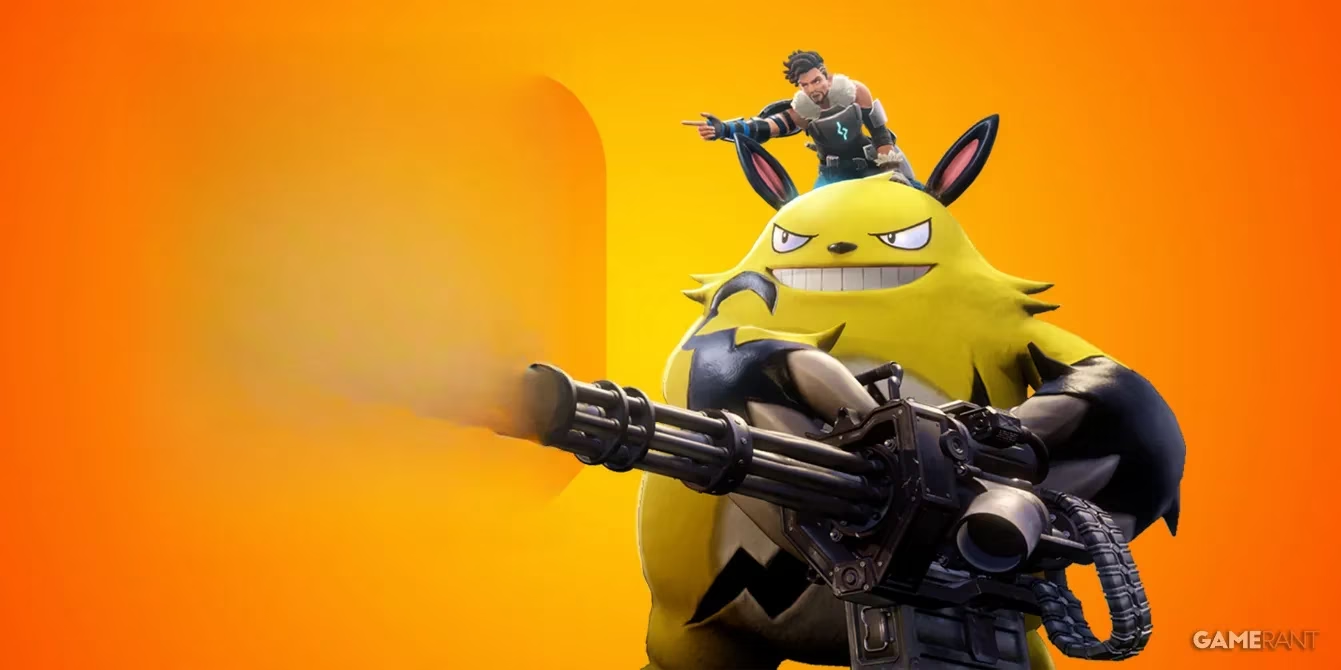
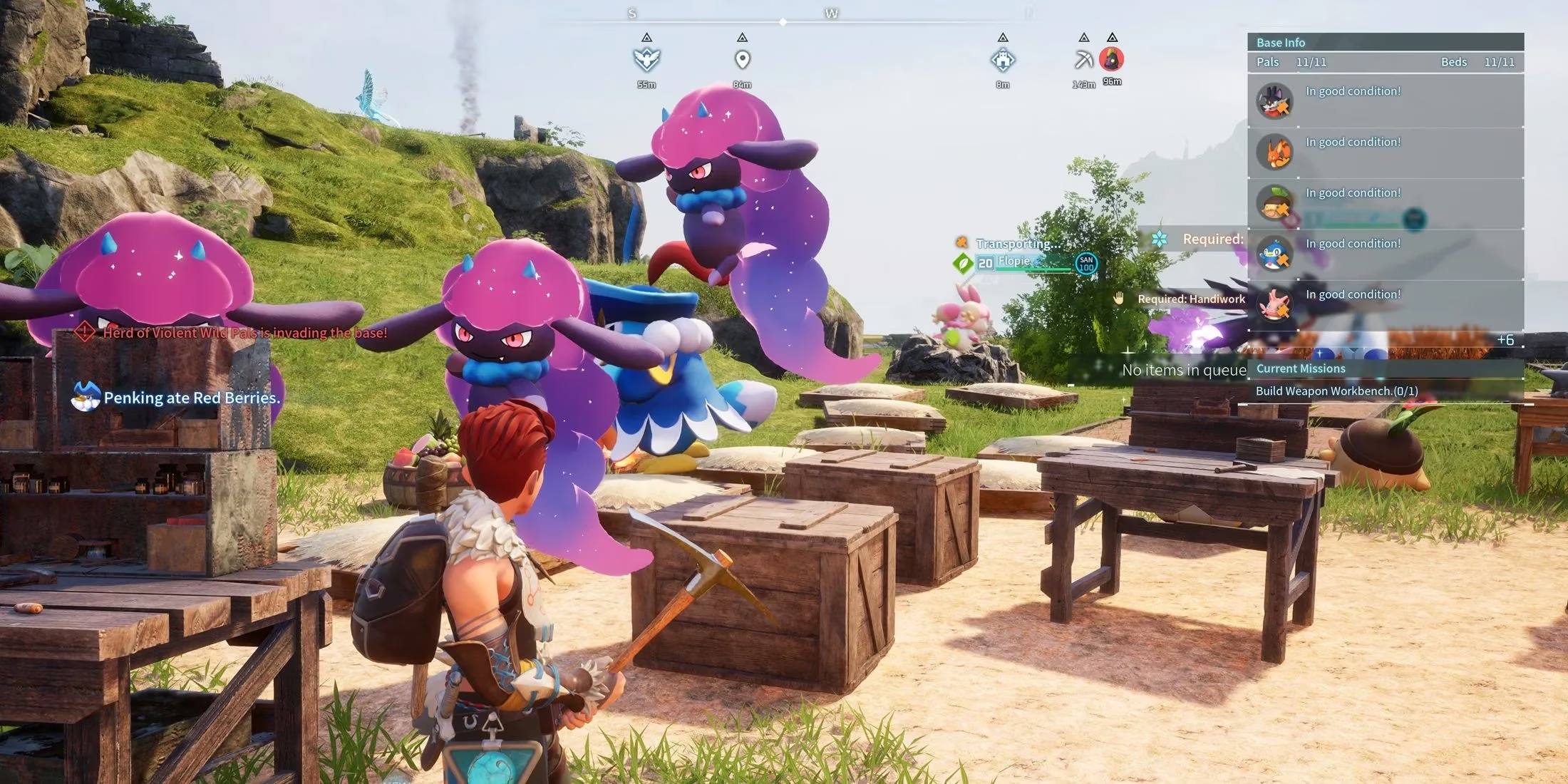
Palworld's deceptively cartoonish veneer is a siren's song, luring players into a world of immense visual depth and complexity. Beneath its cheerful surface lies a demanding ecosystem of over 135 uniquely animated Pals and sprawling, detailed landscapes. The game's bustling bases, where up to 20 Pals can labor simultaneously, are computational storms in a teacup—a beautiful chaos that would likely overwhelm the aging heart of the original Switch.
A glance at the game's PC requirements reveals the chasm:
| Component | Minimum Specs | Recommended Specs |
|---|---|---|
| CPU | i5-3570K 3.4 GHz Quad Core | i9-9900K 3.6 GHz 8 Core |
| Memory | 16 GB RAM | 32 GB RAM |
| Graphics | GeForce GTX 1050 (2GB) | GeForce RTX 2070 |
| Storage | 40 GB SSD | 40 GB SSD |
Contrast this with the Switch OLED's modest 4 GB of memory and custom NVIDIA Tegra chip. Running Palworld on the current Switch would be akin to trying to sail a galleon in a bathtub—the vessel is simply not built for the scale of the journey. The performance struggles of Pokémon Scarlet and Violet on the same hardware serve as a stark, cautionary precedent.
⚖️ The Handheld Benchmark: Steam Deck as a Harbinger
To gauge a potential portable future, one must look to the Steam Deck, a handheld PC that shares a superficial kinship with the Switch but possesses a far mightier computational soul. Even with its enhanced AMD GPU and 16 GB of RAM, Palworld on the Steam Deck is a journey of compromise. Achieving a steady 30 frames per second requires:
-
📉 Turning off Motion Blur
-
📉 Lowering texture quality
-
📉 Accepting resolutions below 1080p
Valve officially labels the title as "playable," a diplomatic term meaning the experience requires significant graphical concessions. If this is the result on the more capable Steam Deck, the path to the original Switch seems not just steep, but vertical.
👥 The Developer's Dilemma: A Small Studio's Titanic Task
Pocketpair, the modest Japanese studio behind the sensation, found itself piloting a rocket ship it had only just finished building. When Palworld launched into Early Access in early 2024, it instantly became a cultural behemoth, attracting over two million concurrent players on Steam. The studio's small team has been rightly focused on stabilizing and expanding the core game for its existing platforms, releasing the substantial Sakurajima update to reinvigorate its community.
Devoting precious resources to porting the game to an aging console like the Switch is, for now, a logistical impossibility. It would be like asking a small crew of artisans to perfectly replicate a sprawling mosaic on a new, unstable wall while still crafting the original. The future for PlayStation 5 appears brighter, hinted at by a strategic partnership with Sony Music Entertainment, but the original Switch remains a distant dream.
🐉 The Pokémon Paradox: A Shadow and a Distinction
The elephant—or rather, the Pikachu—in the room is the undeniable kinship Palworld shares with Nintendo's iconic franchise. The act of capturing colorful creatures is a shared language. However, the games diverge like two rivers from a single mountain; one flows into the serene, turn-based lakes of Pokémon's RPG traditions, while the other cascades into the turbulent waters of survival and base-building. Palworld is less a gentle safari and more a frontier settlement, where Pals are partners in construction and defense as much as they are companions.
While legal threats from The Pokémon Company have thus far remained whispers, the mere perception of similarity may influence Nintendo's willingness to host such a direct competitor, especially with Pokémon Legends: Z-A slated for 2025. Nintendo may view the landscape not as a garden to be diversified, but as a kingdom to be protected.

🔮 The Switch 2: A New Dawn on the Horizon?
This is where the narrative turns from lament to anticipation. The Switch 2, expected by March 2025, promises to be the canvas Palworld has been waiting for. Based on leaks and analyst speculation, its potential specs are a dramatic leap forward:
-
Processor: NVIDIA T239 (a significant upgrade)
-
Memory: 12 GB LPDDR5 RAM
-
Screen: 8-inch LED display
-
Storage: 256 GB internal drive
This hardware profile, potentially comparable to a PS4 in raw power but enhanced by modern features like DLSS, could finally bridge the gap. The new console would not only handle Palworld's visual demands more gracefully but also address the original Switch's notoriously weak online infrastructure—a critical component for Palworld's dedicated servers and multiplayer raids. The Switch 2 could transform the game from a compromised port into a genuine, portable experience.
💎 Conclusion: A Future Forged in Silicon and Speculation
As of 2026, Palworld remains a brilliant constellation visible only in certain skies—PC, Xbox, and, increasingly, the horizon of PlayStation. Its journey to a Nintendo platform is fraught with challenges that are both tangible (hardware limitations, developer bandwidth) and intangible (market dynamics, competitive posturing). The original Switch is a closed door, its hardware a silent sentinel denying entry.
Yet, the imminent arrival of the Switch 2 is a master key being forged. It holds the promise of power sufficient to render Palworld's vibrant chaos and the potential for a business calculus that sees value in diversification. For players dreaming of exploring its survivalist frontiers on a Nintendo handheld, hope now rests not on a miracle, but on the inevitable march of technological progress and the strategic decisions of both Pocketpair and Nintendo in the coming year. The dream is no longer an illusion; it is a question waiting for its answer.